
Income, Expenses and Savings
Understand the three numbers behind your monthly money life: what comes in, what goes out, and what you keep.
1. Your money has a simple monthly flow
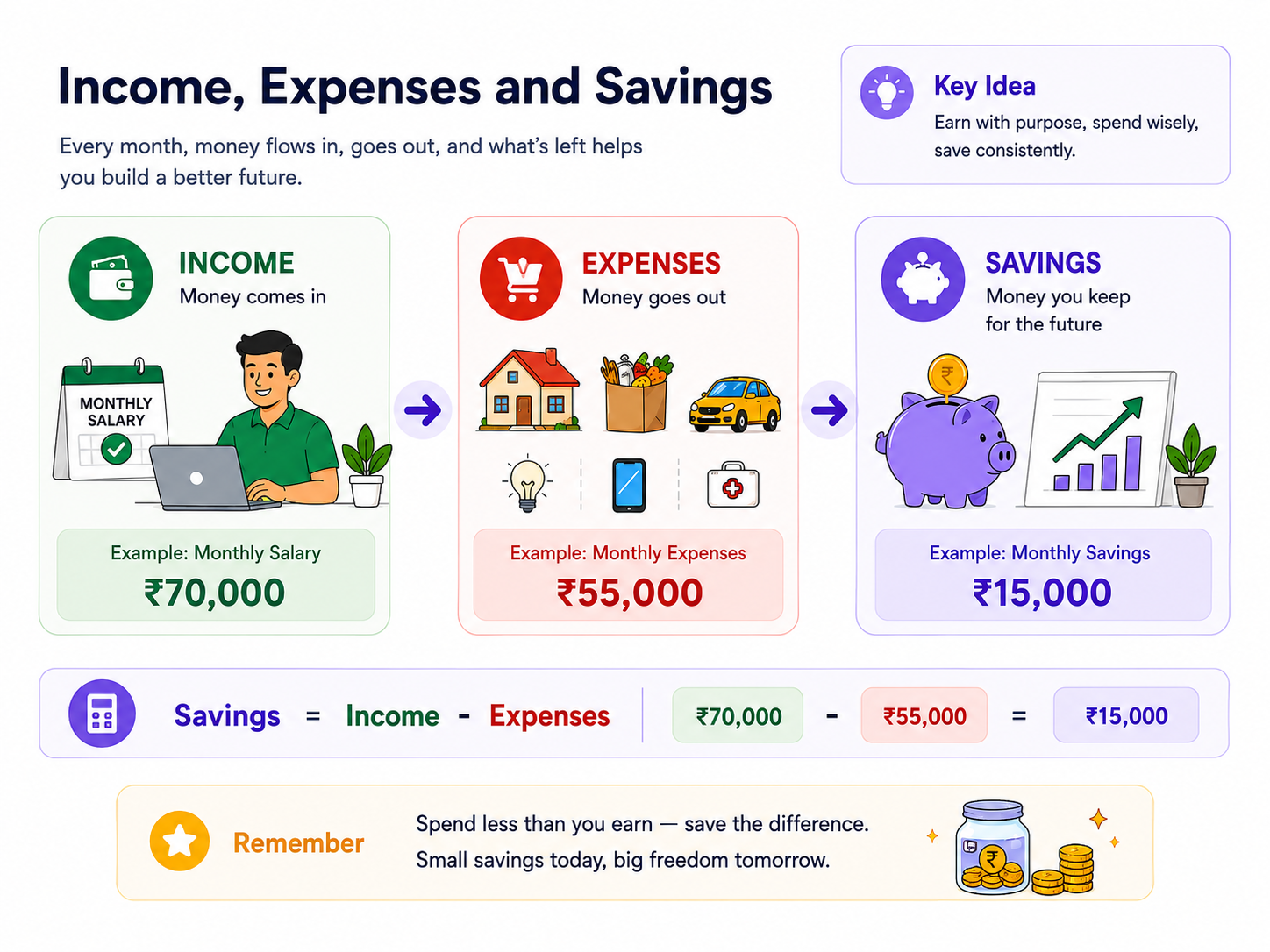
For most people, money follows a simple path: money comes in as income, money goes out as expenses, and whatever remains becomes savings.
If you earn ₹70,000 and spend ₹55,000 during the month, you have ₹15,000 left. That ₹15,000 is your savings for the month.
2. Income is money coming in
Income is money you receive. For an employee, the most obvious example is salary. But income can also come from a business, freelance work, rent, interest or other sources.
When planning your personal finances, use the amount you can actually use — usually your take-home income after payroll deductions — rather than only looking at your CTC or gross salary.

3. Expenses are money going out
An expense is money you use to pay for something. Some expenses are predictable every month. Some change depending on how much you use. Others appear only once or twice a year.

Fixed does not mean permanent
Rent may be similar every month, but it can still change when you move or your agreement is renewed. “Fixed” simply means relatively predictable in the short term.
Credit-card spending still counts
If you buy ₹5,000 of clothes on a credit card today, the expense happened today even though the cash leaves your bank account when the bill is paid later.
4. Savings is the part you keep
Mathematically, savings is simply income minus expenses. But relying only on “whatever is left at the end of the month” can make saving inconsistent.
A stronger habit is to decide your savings amount when income arrives, move that money aside, and then manage the remaining amount for expenses. People often call this paying yourself first.
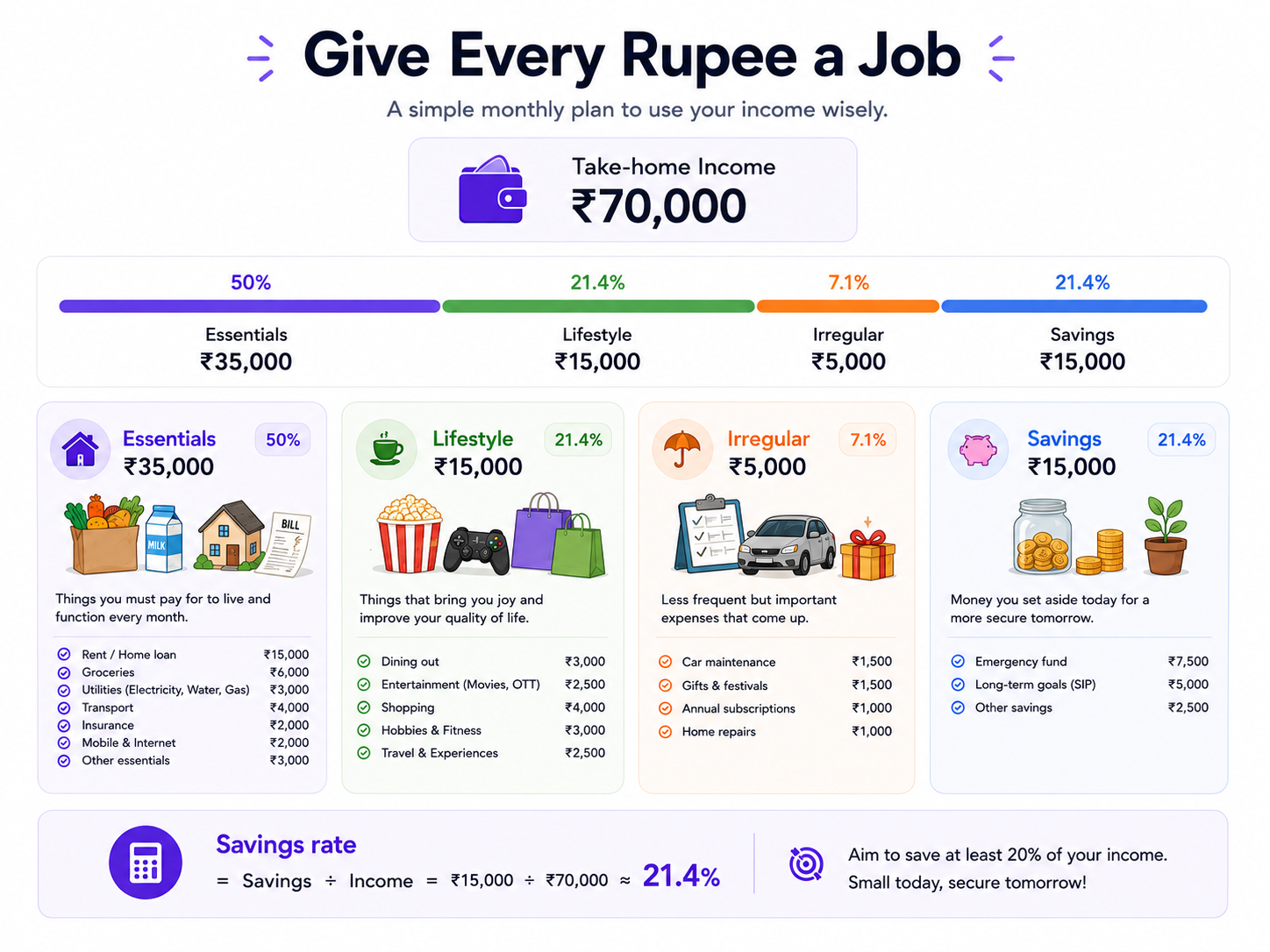
In this example, ₹15,000 of a ₹70,000 take-home income is saved. The savings rate is approximately 21.4%. There is no universal percentage that everyone must follow — your responsibilities, debt, goals and income all matter.
5. Quick check
Priya receives ₹60,000 take-home income this month and her total expenses are ₹47,000. How much did she save?
Answer: B — ₹60,000 − ₹47,000 = ₹13,000.